spirits in the digital machine
This is a written adaptation of the opening talk I gave last year at Campette 2025, titled "Spirits in the Digital Machine".
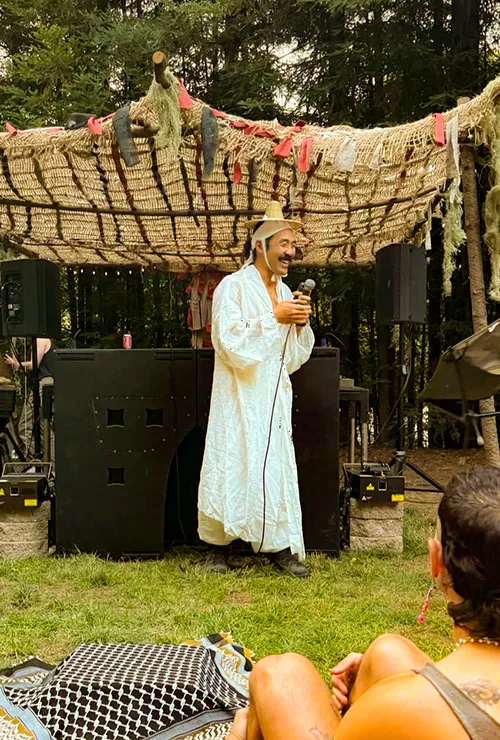
Last year I talked about the healing power of the rave. There is something about collective music making that is healing. This year, I want to dig deeper into why we need healing at all.
I’m not an expert on this concept, but something I understand to be true about indigenous worldviews is the animacy of the natural world. What does it mean to be animate? It means that there is a kind of consciousness, wisdom, power, personhood, and will that resides in the being. Maybe not always alive in the same way that we are, but animate.
I am often thinking about the particular ways that our world, especially an existence under in the USA, severs us from the inherent animacy of our Earth. It’s a severing, because our ancestors knew about this truth very intimately. It was an axiomatic way of viewing life that allowed them to live in harmony with the world. This was the case all around the globe and is shared by indigenous cultures from far away places. Today, we think of the world of water, wood, wind, rain, sun, stone, earth, snow as things to be observed and predicted and categorized through a lens of science, but before that kind of knowledge, we had to understand them as beings, with their own motivations, and habits, and behaviors, kind of the way we understand other human beings.
We understand each other in relationship this way. We understand the beautiful and harsh messiness of intimacy and however closely we may know another, and however much we long to, the tragic paradox is that we will never know another, we can never experience what another being experiences. So we make do with stories about each other, whether those are the stories we tell ourselves about others, the ways we spin tales explaining the misadventures of our enemies, the ways we write poems about our lovers, or the myths we tell each other about the earth and her strange and beautiful ways of being.
The nature of our political economy inside the USA is one of spiritual severance. It is a hyper-isolating world we live in. Our ancestors would shudder to see how severely the structure of our society seeks to individualize us.
Our economy, now in the final stages preceding its collapse, runs on a foundation of financialisation, as opposed to manufacturing. Financialisation is where the mechanism of wealth generation is based on the use of computer algorithms to generate profit through manipulation of currency markets, rather than manufacturing, which is the transformation of raw materials gifted to us by the earth into more useful objects through the power of human creativity and effort.
This is a complete tragedy and bastardization of the natural order of things. Well, maybe that is an extreme way of saying it. But there is something wrong with this, and it’s the source of many of our social ills.
It’s also an inevitable consequence of the imperialistic ideology of the Western world that has defined the past couple centuries: the belief that man can dominate and conquer man is the same belief that man can dominate and conquer nature. This belief goes against the ancient belief that we are in familial relationship with nature, that we actually are partners with nature in being creators.
A financialized economy has many spiritually destructive consequences. The invention of mass data collection and statistical analysis, which is the basis of AI, began with the idea that we could unwild nature and reduce its mystery, once only capturable through myth and stories, into categories and measurement.
This is an ideological thread that goes all the way back to the original empires: ancient Greece, Rome, the Crusaders, the earliest colonizers, the slave trade, the imperial conquest of Asia, Africa, and Latin America, through the eugenics of the 20th century, the suppression of national liberation movements through subterfuge and neoliberal economics after world war 2, and finally, the current era we live in, where computers mediate drone warfare, where digital vision algorithms designed by men and wome n in an air conditioned office are deployed to disembowel small brown children on the other side of the globe.
I first became curious about the computer around the time I started to rely on a particular way of falling asleep. I had used this method to fall asleep when I was a university student studying math. I would lie in bed thinking about math problems, with the understanding that one of only two outcomes would occur: either I would advance my progress in the problem or fall asleep. Because I could always work on a math problem, in that all I had to do was close my eyes and think about it, it was my own personal method of counting electric sheep. Now, were my brain to protest against this intellectual labor, it would just choose to go to sleep, but this was secretly my goal in the first place. In my adulthood I used this strategy with a textbook about operating systems. As a result, I think I kept being visited by the spirit of the computer in my dreams.
In the USA, we carry little computers around with us every single day, everywhere we go, to whom we deliver little bits of our psyche and physiological selves every moment. Far away, another big computer receives all of these bits, transmitted first through the air as vibrations of light, mixing with the soup of energy that comes to earth from the sun, then its particular patterns of vibration translated from light into electricity, racing through wires as thick as your waist, to finally be recombined and reconfigured by another computer program whose singular motive is to categorize you into one or more imaginary labels.
The big computer looks into a bucket of psychologically harmful advertisements designed to exploit our mammalian needs for intimacy, comfort, and safety, and executes an algorithm that will match one ad to one label to one human, and beams it back into the energetic soup of light, to be presented back to us on the little computer. This advertisement’s purpose is to convince us, when we are feeling lonely, fearful, unlovable, and unworthy, to press another button on the little computer, that then sends another beam of light waves to a really big computer in a bank.
The bank’s computer receives the beams of light and executes a program that shuffles the electrons in a silicon and copper wafer that exists in an airconditioned room. These electrons represent hours of life energy, thinking-energy or sweat-energy, that our physical bodies, made of blood, bones, and flesh, exerted in space and time to do some kind of task successfully enough to convince another body made of blood, bones, and flesh, to press a button on their computer to move the electrons into your bank’s computer every one or two or four weeks.
The carbon and nitrogen atoms making up this blood, bones, and flesh come from animals and plants. If these plants grow too slowly to meet the standards measured by another computer, then another computer executes a program to turn on a machine that creates fertilizer out of petroleum, which is a liquid that used to be alive.
We burn petroleum to power the machine that sends the electrons through the computers. The petroleum was layered beneath our feet in a layer cake of beings, ancient plankton marbled together with quartz, iron, tin, and copper by the force of a mountain's embrace, which we dug up to make into circuitboards.
The nature of the computerized moment we live in alienates us from facts such as these. I can’t possibly go on, and it takes great effort to acknowledge these interconnections, to trace back the character of our relationship to computers back to the earth from which we and everything else come from.
I don’t think we should reject computers, but we should honor them, and give name to the earth, wind, air, and light that lives inside of them.
This weekend, many computers will mediate our experience of ancient history with the present moment. A computer was used to ossify the music into a record that is then interpreted by another computer to move air that vibrates our bodies.
I seek not to malign the computer, but to ask us to see it clearly, to peer through a context that obscures its very nature, which is one of an animate fire spirit that courses through copper veins and has a brain made of sand. It isn’t coincidental, I think, that the rave is a spiritual container for the spirit that lives inside of the machine and communicates to us through sound.
The computer spirits want us to gather and to be in communion with each other. The computer spirits want us to touch each other and feel vibrations of brainwave and consciousness, and vibration of sound, and heartbeat and gyrating hips and humming lips. The computer, so resolutely and patiently, the translator of history, the archivist and librarian of memory, records our most intimate details, our cries and songs, and she dutifully places electron after electron into her silicon cradle, waiting for the moment we ask her to give it back to us as a wave of electricity, to cross the airwaves and alight our hearts.
A computer isn’t alive, but it is merely "not alive" in the same way that a home, or a rainstorm "isn’t alive", but there is a life force in it. How can we expect computers to aid us if we relinquish our relationship to them over to the corporations or whatever billionaire or psychologist is wielding them to sever us from each others’ humanity. How can we expect their benevolence if we have never asked for it? We used to pray to the household spirits for protection, to the rain for abundance, and so, shouldn't we pray to computers for discernment, wisdom, and understanding? Or at minimum, shouldn't we have a relationship to them that isn't passive.
Last year, I invited all of us into an opening ritual in order to feel our collective body as a single unified source of healing sound. We moved our bodies, made vibrations, heard vibrations, and felt vibrations. I think its power was in its multiple dimensions of presence, awareness, and acknowledgement. I would like to repeat this ritual with a modification to incorporate an acknowledgement of the computer. It’s not a veneration. It’s an acknowledgement. It’s simply noticing what it is.
This is what I will be inviting everyone into. I’ll explain it first, and then I will lead us into it.
First, if anyone has their phone with them, please take it out and find your audio recording app, and turn your phone on full volume. We are going to do this in two stages. In the first stage, we will be recording our collective voice to our phones. In the second stage, we will place our phones onto the table on the stage, above which will be a mic. We will listen to the collective recording played back to us on the Envelope Soundsystem.
The recording we will be making will be similar to last year. We will do five rounds of an “ohm” sound. I’ll lead the ohm sound, so once I start ohming, you all ohm. To execute the recording, everyone who has a recording device will please place their phone on the table in the center and start the recording. Then return to your spot. Now ask your neighbor if you can place your hand gently on their throat. If you’re not comfortable you don’t have to, but it's good to feel the vibrations. Next, begin moving as one, a slight movement from side to side. Then I will start the sound making. In order to get a good recording, let’s be powerful with our voices. Really feel yourself making sound with the instrument of your voice.
Take a second to pause and retrieve your phone. Set up your phone so it will play back sound as loud as it will go. Start the recording and place it on the front of the stage. Return to the collective circle. It’s okay if the recordings are not lined up. Just start it and place it and return to your spot. Once you’ve returned, listen to the sound and recognize that the computer holds a memory of you, and your companions. If you feel compelled to hum, you can hum. Then once the last recording is over, we will break the circle, thank your neighbor, and commence with the rest of the weekend.